The National Pension System (NPS) is one of the most efficient tools for long-term retirement planning in India. Its primary objective is to help subscribers build a substantial retirement corpus through disciplined savings. However, life is unpredictable, and financial emergencies or significant life goals often arise before one reaches the retirement age. Recognising this need for liquidity, the Pension Fund Regulatory and Development Authority (PFRDA) has designed provisions for NPS partial withdrawal.
While the bulk of your savings remains locked in to benefit from the power of compounding, you still have access to funds when you need them most.
What is Partial Withdrawal in NPS?
A partial withdrawal refers to the facility that allows a subscriber to withdraw a specific portion of their accumulated savings from the NPS account before the account matures (i.e., before the subscriber turns 60). Unlike a “premature exit,” which involves closing the account entirely, a NPS partial withdrawal keeps your account active. You can continue contributing to the scheme even after withdrawing funds, ensuring your retirement planning stays on track.
It is important to note that this facility is primarily designed for the Tier 1 account, which is the mandatory pension account. The Tier 2 account, being a voluntary savings account, operates differently and offers far greater liquidity.
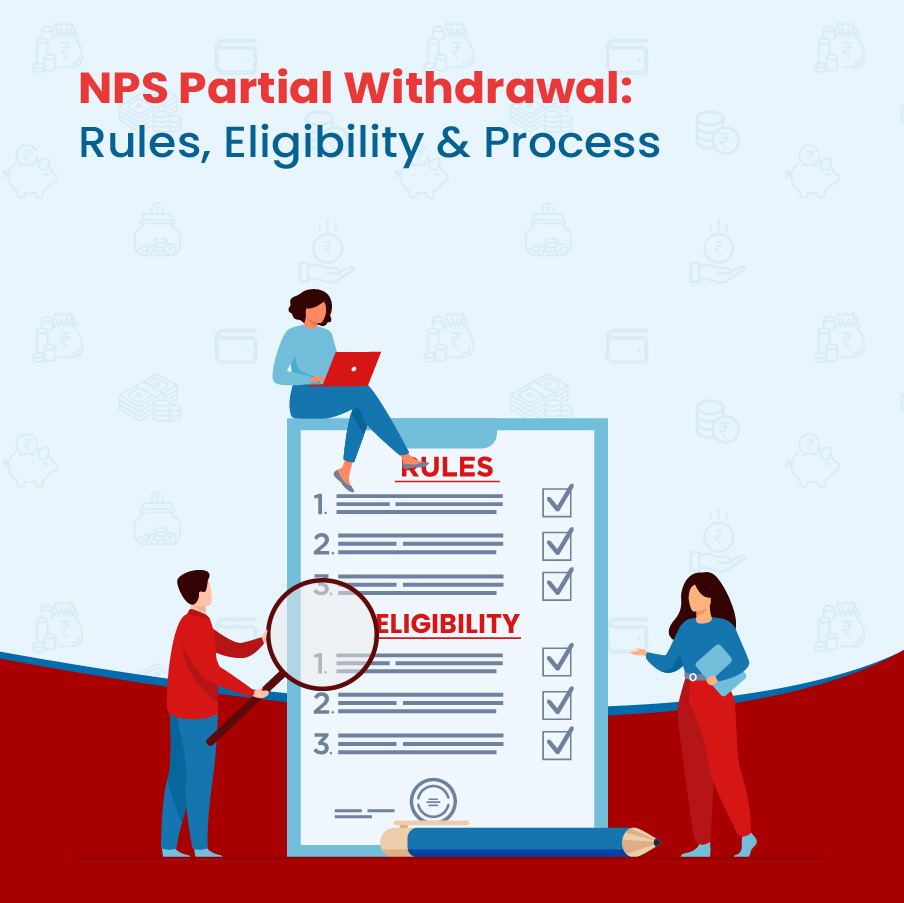
NPS Partial Withdrawal Eligibility Criteria
To preserve the sanctity of the pension fund, the PFRDA has established strict eligibility criteria. Withdrawals are allowed only under specific circumstances.
To be eligible for an NPS partial withdrawal, a subscriber must fulfil the following conditions:
- Minimum Tenure: You must have been a subscriber to the National Pension System for at least 3 years from the date of joining.
- Withdrawal Limit: You can withdraw only up to 25% of your own contributions. It is crucial to note that you cannot withdraw the employer’s contribution or the returns (interest/gains) generated on the corpus.
- Frequency: A subscriber is allowed a maximum of 4 withdrawals during the entire tenure of the subscription. There should be a minimum gap of four years between each.
NPS Partial Withdrawal Rules
The NPS partial withdrawal rules are designed to ensure funds are used for genuine financial needs. The regulatory authority has specified a list of purposes for which you can initiate a withdrawal.
Permitted Reasons for Withdrawal:
- Higher Education: For the higher education of the subscriber’s children (including legally adopted children).
- Marriage: For the marriage expenses of the subscriber’s children.
- Residential House: For the purchase or construction of a residential house or flat in the subscriber’s own name or jointly with their spouse. (Note: This is not permitted if the subscriber already owns a residential house, other than ancestral property.)
- Critical Illness: For the treatment of specified illnesses for the subscriber, spouse, children, or dependent parents. These illnesses include Cancer, Kidney Failure (ESRD), Primary Pulmonary Arterial Hypertension, Multiple Sclerosis, Major Organ Transplant, Coronary Artery Bypass Graft, Aorta Graft Surgery, Heart Valve Surgery, Stroke, Myocardial Infarction, Coma, Total Blindness, Paralysis, Accident of serious/life-threatening nature, and COVID-19.
- Skill Development: For re-skilling or self-development activities to enhance employability, including vocational courses and professional certifications.
- Start-up Ventures: For establishing a new venture or start-up in which the subscriber is actively involved.
Tier 1 Withdrawal Rules
The Tier 1 account is the core retirement account, and therefore, the NPS tier 1 partial withdrawal rules are restrictive. As mentioned earlier, you can only withdraw 25% of your own principal contribution.
For example, if you have contributed ₹5 Lakhs and your employer has contributed ₹5 Lakhs, and the total corpus with interest is ₹15 Lakhs, your withdrawal eligibility is calculated only on your ₹5 Lakhs. Thus, you can withdraw 25% of ₹5 Lakhs, which is ₹1.25 Lakhs.
Furthermore, there is a requirement for a gap of at least 4 years between two partial withdrawals. However, this 4-year gap condition is waived if the withdrawal is for the treatment of a specified illness.
Tier 2 Withdrawal Rules
The rules for NPS tier 2 are vastly different. Since Tier 2 is a voluntary add-on account, it functions essentially like a mutual fund or a savings account.
- No Lock-in: There is no lock-in period for Tier 2 accounts.
- Unlimited Withdrawals: You can withdraw your money at any time.
- No Purpose Restrictions: You do not need to state a reason (like marriage or education) to withdraw from Tier 2.
Technically, the concept of “partial withdrawal” applies strictly to Tier 1. For Tier 2, it is simply a redemption of units. If you are looking for liquidity without paperwork, the Tier 2 account is far superior, though it lacks the tax benefits of Tier 1.
NPS Partial Withdrawal Process
With the digitisation of the NPS, the withdrawal process has become seamless and paperless. Subscribers can choose between online and offline modes.
NPS Partial Withdrawal Online Process
For a fast, paperless settlement (usually T+2 or T+3 days), the NPS partial withdrawal online process is highly recommended. You can easily initiate this journey by starting at the HDFC Pension portal:
- Access Your Account: Visit the official HDFC Pension website. From the subscriber services or login section, you will be securely directed to your designated CRA portal (such as Protean or KFintech). Log in using your PRAN and password.
- Initiate Request: Once logged into the CRA dashboard, navigate to the “Transact Online” or “Withdrawa” tab and select “partial withdrawal from NPS tier 1”
- Verify Eligibility: The system will automatically calculate and display your eligible withdrawal amount based on your own accumulated self-contributions.
- Select Reason: Choose the permitted reason for your withdrawal (e.g., Medical Emergency, Higher Education, Home Purchase) from the drop-down menu.
- Self-Declaration: Read and accept the online self-declaration. Thanks to updated PFRDA regulations, you usually do not need to upload physical proof; your digital declaration is sufficient.
- Authenticate: Verify your registered bank account details and submit the request using an OTP sent to your registered mobile number and email ID. Once approved, the NPS tier 1 partial withdrawal online request is processed, and units are redeemed.
Offline Process
If you prefer a manual route, you can submit a physical request:
- Download the “Partial Withdrawal Form” (Form 601-PW) from the CRA website.
- Fill in the details, specifying the percentage to be withdrawn and the reason.
- Attach a self-declaration stating the purpose.
- Submit the form to your Point of Presence (PoP) or Nodal Office.
For further queries, you can refer to the Customer Service page on our website.
Documents Required for NPS Partial Withdrawal
Previously, subscribers had to submit proof of the event (e.g., wedding invitation, admission letter, medical bills). However, under the current NPS withdrawal rules for tier 1, the PFRDA allows processing based on Self-Declaration.
- For Online Requests: Usually, no documents are required to be uploaded. By clicking the declaration button, you legally affirm that the reason is genuine.
- For Offline Requests: You submit a signed self-declaration form.
- Exception: In cases of critical illness, the Nodal Office or CRA may sometimes request a medical certificate if the self-declaration is deemed insufficient, though this is rare in the fully online flow.
Tax Rules on Partial Withdrawal from NPS
Tax efficiency is one of the biggest advantages of the NPS tier 1 partial withdrawal.
- Tier 1: Any partial withdrawal from NPS tier 1 is completely tax-free. The amount you withdraw (up to the 25% limit) is exempt from Income Tax under Section 10(12B) of the Income Tax Act. This makes it a highly effective source of emergency funds compared to breaking a Fixed Deposit or redeeming mutual funds, which might attract capital gains tax.
- Tier 2: Withdrawals from the Tier 2 account do not enjoy this benefit. Since Tier 2 does not offer tax benefits on contributions (except for specific government schemes), the withdrawals are taxable. The gains made on Tier 2 withdrawals are generally added to your income and taxed at your marginal slab rate (or treated as capital gains depending on the holding period and asset class), making NPS withdrawals from Tier 2 less tax-efficient than Tier 1 partial withdrawals.
How Partial Withdrawal Affects Your NPS Corpus?
When you withdraw funds, you are not just taking out cash; you are removing capital that was compounding for your retirement.
Consider this example: Imagine you are 35 years old and you withdraw ₹1 Lakh from your NPS account for a vacation (disguised as self-development).
- Withdrawn Amount: ₹1,00,000
- Years left for retirement: 25 years
- Expected Return: 10% per annum
If that ₹1 Lakh had remained invested, it would have grown to approximately ₹10.8 Lakhs by the time you retired at 60. By withdrawing it now, you are essentially reducing your retirement corpus by over ₹10 Lakhs.
Therefore, while the NPS tier 1 partial withdrawal online facility is easy to use, financial advisors recommend using it only as a last resort.
The Bottom Line: Withdraw Wisely
The NPS partial withdrawal facility is a thoughtfully designed feature that adds necessary liquidity to a long-term pension product. It ensures that subscribers are not left stranded during genuine financial crises or major life events like buying a home or funding a child’s education.